How Many Boxes of Contact Lenses Do I Need? 30-, 90-, 3-, and 6-Pack Examples
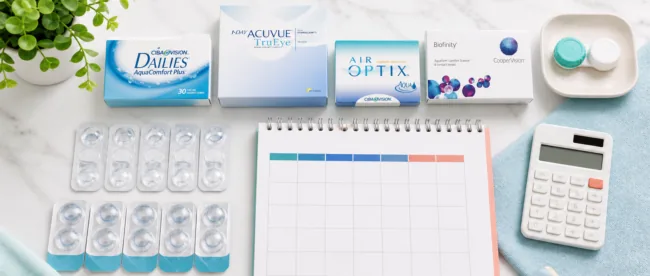
Short answer to “How many boxes of contact lenses do I need?”: A pack number tells you how many individual contact lenses are in the box, not how many pairs. Calculate the lenses needed for each exact parameter group, divide that number by the pack size, and round up each group separately. A 30-pack of daily disposables covers one eye for 30 wearing days. A 6-pack of monthly lenses covers one eye for six monthly replacement cycles.
Your result depends on four details: the replacement schedule, how often you plan to wear the lenses, whether both eyes use the same complete parameters, and which pack sizes are available for your prescribed lens. The examples below assume that you wear lenses in both eyes and follow the replacement schedule given by your eye care professional.
First, Count Lenses Rather Than Pairs
The number printed on a standard soft contact lens box normally refers to individual lenses:
- A 30-pack contains 30 individual lenses.
- A 90-pack contains 90 individual lenses.
- A 3-pack contains three individual lenses.
- A 6-pack contains six individual lenses.
That distinction matters because most people use one lens in each eye. One day of two-eye wear therefore uses two daily disposable lenses. One monthly replacement cycle for both eyes requires two monthly lenses.
A box is also filled for one specific combination of brand, model, and prescription parameters. If the right and left eyes differ, the lenses for one eye cannot simply be taken from the other eye’s box.
How to Calculate How Many Contact Lens Boxes You Need
Use this method for each exact parameter group:
- Choose the supply period you want to cover.
- For daily disposables, count the planned wearing days per eye. For monthly lenses, count the monthly replacement cycles per eye.
- Group together only eyes that use the same brand, model, and all applicable parameters.
- Multiply the per-eye requirement by the number of eyes in that group.
- Divide by the number of lenses in the box.
- Round the result up to the next whole box for that group.
- Add the whole-box results from all parameter groups.
Formula: boxes for one parameter group = lenses required for that group divided by lenses per box, rounded up.
When can both eyes use the same boxes?
For standard soft lenses, both eyes can draw from the same set of boxes only when the complete prescribed product and parameters match. That includes the exact brand and model, Power, BC, and DIA, plus CYL and AXIS for toric lenses or ADD and any brand-specific design value for multifocal lenses. Matching Power alone is not enough.
If you are unsure what the abbreviations on the box mean, our guide to BC, DIA, Power, CYL, and AXIS explains the main ordering fields. Use the values from your current contact lens prescription or packaging; do not estimate them for the sake of combining boxes.
30-Pack and 90-Pack Daily Disposable Examples
A true daily disposable lens is used once and discarded after removal. If you wear lenses in both eyes every day, you need two lenses per day. The table shows the minimum whole-box quantity under that assumption.
| Supply needed | Pack size | Both eyes have identical parameters | Eyes have different parameters |
|---|---|---|---|
| 30 wearing days | 30-pack | 2 boxes total | 2 boxes total: 1 per eye |
| 30 wearing days | 90-pack | 1 box total, with 30 lenses left | 2 boxes total: 1 per eye, with lenses left in each box |
| 90 wearing days | 30-pack | 6 boxes total | 6 boxes total: 3 per eye |
| 90 wearing days | 90-pack | 2 boxes total | 2 boxes total: 1 per eye |
A single 30-pack lasts 30 days for one eye. If both eyes use identical parameters and share that box, it supplies 15 days of two-eye wear. In the same way, one 90-pack lasts 90 days for one eye or 45 days for two eyes with identical parameters.
If daily disposables are listed on your prescription, you can compare daily disposable contact lens pack sizes and calculate the required quantity before adding boxes to your cart.
3-Pack and 6-Pack Monthly Contact Lens Examples
Monthly lenses use a different unit. Instead of counting wearing days, count prescribed monthly replacement cycles. One monthly lens serves one eye for one cycle when it is worn, cared for, and replaced as directed. It does not become a fresh lens each day.
The table assumes one new monthly lens per eye for each monthly cycle:
| Supply needed | Pack size | Both eyes have identical parameters | Eyes have different parameters |
|---|---|---|---|
| 3 monthly cycles | 3-pack | 2 boxes total | 2 boxes total: 1 per eye |
| 3 monthly cycles | 6-pack | 1 box total | 2 boxes total: 1 per eye |
| 6 monthly cycles | 3-pack | 4 boxes total | 4 boxes total: 2 per eye |
| 6 monthly cycles | 6-pack | 2 boxes total | 2 boxes total: 1 per eye |
| 12 monthly cycles | 3-pack | 8 boxes total | 8 boxes total: 4 per eye |
| 12 monthly cycles | 6-pack | 4 boxes total | 4 boxes total: 2 per eye |
A 3-pack is a three-month supply for one eye, not a three-month supply for a pair of eyes. If both eyes use the same parameters, one 3-pack provides one complete two-eye replacement cycle plus one extra individual lens. You still need a second box to cover both eyes for three full monthly cycles.
Likewise, a 6-pack covers one eye for six monthly cycles. For two eyes with identical parameters, one box covers three complete cycles. If the eyes differ, one 6-pack for each eye provides six cycles for both eyes.
Why You Must Round Up Each Parameter Group Separately
Combining both eyes before rounding is correct only when their complete parameters are identical. When the parameter groups differ, calculate and round each eye separately.
Example: 37 days of daily disposable wear
If both eyes have identical parameters, you need 74 lenses. With 30-packs, 74 divided by 30 is 2.47, so you round up to three boxes.
If the eyes have different parameters, each eye needs 37 lenses. For the right eye, 37 divided by 30 rounds up to two boxes. The left eye also requires two boxes. Your total is four boxes, not three, because a leftover right-eye lens cannot fill a left-eye prescription.
Example: 365 days with 90-packs
Two eyes require 730 daily disposable lenses for 365 days of wear. With identical parameters, 730 divided by 90 rounds up to nine boxes. With different parameters, each eye needs 365 lenses, which rounds up to five 90-packs per eye, or ten boxes total.
This difference is caused by whole-box rounding, not by a different wearing schedule. For a shorter period that divides evenly by the pack size, matching and different parameters may produce the same total number of boxes.
What If You Wear Daily Disposables Only Some Days?
Count the days on which you realistically expect to wear the lenses, rather than every calendar day. If you plan to wear daily disposables three days per week for 12 weeks, that is 36 lenses per eye. A wearer whose eyes have different parameters would need two 30-packs per eye, for four boxes total. If both eyes have identical parameters, 72 lenses can come from three shared 30-packs.
Do not use this wearing-day method for monthly lenses. A monthly replacement schedule is based on the prescribed replacement interval after a lens is opened, not on accumulating 30 separate days of wear. Follow the product instructions and the schedule set by your eye care professional even if you do not wear the lens every day.
Common Box-Quantity Mistakes
- Reading the pack number as pairs. A 30-pack contains 30 lenses, not 30 right-and-left pairs.
- Calling one 30-pack a one-month supply for both eyes. It is approximately 30 days for one eye, but only 15 days for two identical eyes worn daily.
- Grouping eyes by Power alone. Any difference in the complete prescribed brand, model, or applicable parameters creates a separate group.
- Rounding after combining different prescriptions. Round each parameter group first, then add the boxes.
- Counting a monthly lens as 30 wearing days. Follow the prescribed calendar replacement interval once the lens is opened.
- Extending the replacement schedule to use fewer boxes. Pack-size math should never change how long a lens is worn.
A Quick Check Before Ordering
- Confirm the exact brand and model on your current contact lens prescription.
- Compare every applicable parameter for the right and left eyes.
- Confirm whether the product is daily disposable, monthly replacement, or another schedule.
- Check that the chosen pack size is offered in your exact parameters; availability can vary by lens design.
- Calculate and round boxes separately for every parameter group.
- Review the selected parameters, pack size, and quantity before completing the order.
After the calculation confirms the same professionally fitted model and every parameter for each eye, you can buy the same lenses in the pack size you calculated; pack-size savings never justify changing the model or values.
If you intentionally want extra lenses for travel or an accidentally dropped lens, add that reserve after calculating the basic supply. Do not create a reserve by planning to wear daily lenses again or to stretch monthly lenses beyond their prescribed replacement date.
Keep the Replacement Schedule Separate From the Shopping Math
Daily disposable lenses are designed for one-time use and should be discarded after the day’s wear. Planned-replacement lenses must be replaced on the schedule prescribed for the specific product and wearer. A larger box gives you more replacement lenses; it does not authorize longer wear for each lens.
Contact lenses are prescription medical devices in the United States. Use the exact lens prescribed for you and follow your eye care professional’s wear, care, and replacement instructions. Remove your lenses and contact an eye care professional if you develop eye pain, marked redness, sudden blurry vision, unusual light sensitivity, discharge, or persistent discomfort.
Frequently Asked Questions
Is a 30-pack of contact lenses 30 pairs?
No. It contains 30 individual lenses. It supplies one eye for 30 daily wears or two eyes with identical parameters for 15 daily wears.
How long does a 90-pack of daily contacts last?
One 90-pack lasts 90 wearing days for one eye. If both eyes use identical parameters and share the box, it lasts 45 days. If the eyes have different parameters, you need one box for each eye to cover 90 wearing days.
How long does a 6-pack of monthly contacts last?
It covers one eye for six monthly replacement cycles. For two eyes with identical parameters, one 6-pack covers three complete cycles. For two different parameter sets, two 6-packs—one for each eye—cover six cycles.
Do I need separate boxes when my eyes have different powers?
Yes. Each box contains one parameter combination, so a different Power requires a separate box. Separate boxes are also necessary when any other applicable value differs, including CYL, AXIS, ADD, BC, DIA, brand, or model.
Can I combine my eyes if the Power is the same but another value differs?
No. Treat each complete parameter combination as its own group. The lenses can share boxes only if the prescribed product and all applicable values match.
Does a monthly lens last for 30 times I wear it?
Not necessarily. Monthly replacement refers to the prescribed replacement interval after opening, rather than a bank of 30 separate wears. Follow the manufacturer’s instructions and your eye care professional’s schedule.
Choose a Pack Size That Fits Your Supply Period
The reliable way to answer “How many boxes of contact lenses do I need?” is to count individual lenses, separate different parameter groups, and round each result up to a whole box. That method works whether you are planning a short trip, a 90-day refill, or a longer supply.
Once you have confirmed your exact lens model, parameters, and required supply period, browse monthly contact lenses by available pack size and choose the whole-box quantity that matches your calculation.
Related posts: