Contact Lenses Out of Stock? What to Do Before You Reorder
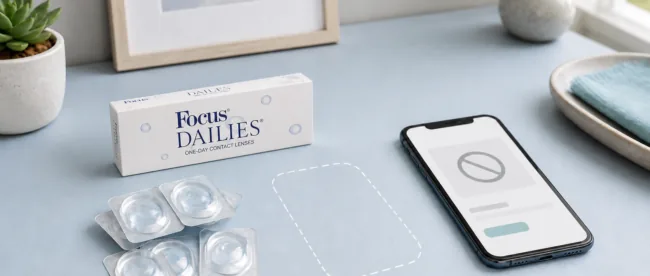
If your exact contact lenses are out of stock, do not choose the nearest power, a similar brand, or an older lens to bridge the gap. First confirm which product is unavailable and whether the shortage is temporary. Use backup glasses if needed. If the lens has been discontinued, an eye-care professional should evaluate any replacement. A supply problem changes availability—not which lens is appropriate for your eyes.
What “out of stock” does—and does not—mean
An out-of-stock notice usually describes one seller’s inventory at one moment. It does not prove that the manufacturer has stopped making the lens, that every version is unavailable, or that another product is an approved substitute. Sometimes the unavailable item is one package size or one optical design within a larger product family.
Retailers also use stock terms differently. Before making a decision, ask what the status means for the exact item you normally wear.
| Status | What it usually indicates | Useful next step |
|---|---|---|
| Out of stock | The seller cannot fulfill that item from current inventory | Ask whether more inventory is expected and confirm the exact item affected |
| Backordered | The item is unavailable now, but the seller expects a later supply | Ask for the current estimate, cancellation terms, and whether the date may change |
| Discontinued | The manufacturer has ended or plans to end that product | Ask an eye-care professional to evaluate a different lens rather than choosing one yourself |
| Recalled | Specific products or lots are subject to a corrective action | Follow the manufacturer’s or FDA’s instructions for the exact product and lot |
A removed product page is not enough to identify which of these situations applies. The page may have moved, a package may be temporarily unavailable, or the retailer may no longer carry it even though the manufacturer still makes it.
Confirm that you are checking the exact lens
Contact lens product families often contain several designs with similar names. A spherical lens, a toric version for astigmatism, and a multifocal version may share most of the branding while functioning differently. Daily and reusable products can also sit under the same family name.
Use a recent unopened box, an order history, or the product information supplied by your eye-care professional as the reference. Check the complete product name rather than relying on the brand logo or the first few words of a listing. Compare the information for the right and left eyes separately because they may not use the same option.
Once the full product name and every parameter match the exact lens fitted for you by an eye-care professional, you can check stock for the lenses you already wear; a different model or value requires professional approval.
Also check whether the store is showing a different package size of the same lens or a genuinely different model. Package quantity alone does not determine fit, but a similar package design can make two products look interchangeable when they are not.
Why a “close match” is not a safe substitute
FDA consumer guidance warns that contact lenses from different brands can look alike while differing in material and shape. Matching one visible number does not establish that another lens will center, move, retain its shape, or provide the same vision on your eye.
Do not switch because a product description says “similar,” because a marketplace suggests an alternative, or because another lens has the same correction power. Even two models from the same manufacturer can have different materials, edge profiles, optical designs, or wearing instructions.
The safe alternative to guessing is a professional refit. An eye-care professional can place the proposed lens on the eye, assess its movement and coverage, check vision, and decide whether follow-up is needed. An online comparison cannot perform those steps.
A safe decision path when your contact lenses are out of stock
- Pause before adding another product. Do not let a “recommended alternative” button make the decision for you.
- Identify the exact unavailable item. Confirm the full model and design, not just the brand family.
- Ask the seller for the current status. Find out whether the item is temporarily unavailable, backordered, no longer carried, discontinued, or affected by another issue.
- Check how long your existing supply will last without extending wear. Count only sealed, unexpired lenses that you can use according to their labeled schedule.
- Plan to use glasses during any gap. CDC guidance recommends carrying backup glasses in case contact lenses must be removed.
- Contact your eye-care professional if another lens is necessary. A different brand or model should be evaluated rather than selected from a comparison chart alone.
Checking availability for the lens you already wear? Review current daily disposable contact lenses or monthly contact lenses, and add a product only after the full model and design match the lens intended for you.
What to ask before accepting a backorder
A backorder may be reasonable when you have enough lenses to wait without changing your wear routine. Treat any restock date as an estimate unless the seller clearly states otherwise. Supply dates can move, and international delivery adds another variable after the product becomes available.
Ask the seller:
- Is the backorder for the complete product line or only the exact version selected?
- Does the estimate come from the warehouse, distributor, or manufacturer?
- Will the full order wait, or can available items ship separately?
- Can the order be canceled if the estimated date changes?
- When will payment be captured, and how will status updates be provided?
These are customer-service and policy questions, so the answers vary by retailer. Save the order confirmation and any written estimate. If you will run out before the likely delivery date, plan on glasses or speak with your eye-care professional instead of stretching the lenses you have.
If the lens has been discontinued
A discontinued model may have no one-to-one replacement. A manufacturer might introduce a newer product with a familiar brand name, but a newer lens is not automatically the same lens. It may use a different material, replacement schedule, optical design, or range of available options.
Bring the old box or a clear photograph of every side to an appointment. Tell the eye-care professional how often you wore the lens, how it felt at the beginning and end of the day, and whether vision fluctuated. That information can help guide the evaluation, but it does not replace trying and assessing the proposed lens.
If a seller still has remaining stock, check that the packaging is sealed and the lenses are unexpired. Limited old stock can solve a short-term supply problem, but it is not a long-term plan for a product that will no longer be available.
Do not extend a replacement schedule to cover the gap
Running low can make an extra day seem harmless. It is not a sound supply strategy. CDC guidance says true daily disposable lenses are used once and discarded; wearing them for more than one day may cause discomfort or other complications. Reusable lenses also need to be replaced on the schedule recommended for that specific product and wearer.
Cleaning does not reset the age of a lens. It also does not turn a daily disposable into a reusable lens. Do not sleep in daily-wear lenses, reuse a single-use lens, or add days to a reusable lens merely because a shipment is late.
Do not respond to a shortage by wearing any lens past its replacement schedule or by guessing at a lens for the missing eye. If you do not have the appropriate lenses for both eyes, use glasses unless your eye-care professional has given you different instructions.
Avoid risky emergency purchases
A shortage can push shoppers toward unfamiliar marketplaces, auction listings, or old boxes offered by private sellers. Price and immediate availability do not establish that a product was stored correctly or came through an authorized supply chain.
When an order arrives, compare the delivered product with what you expected before opening anything. Check the full product name, design, package quantity, expiration date, and the information for each eye. Do not use a lens from a blister that is open, leaking, visibly damaged, or not fully sealed. If the seller sends a different brand, keep it unopened and contact the seller and your eye-care professional.
If a shortage is connected to a recall, follow the notice for the exact model and lot number. Do not assume that every product under the brand is affected, and do not keep using an affected lot merely because it looks normal.
Build a small reorder buffer
The best time to handle a stock problem is before the last pair is opened. Set a reminder based on your normal use and add extra time for weekends, holidays, seller processing, and shipping. Review the reminder before travel or another period when receiving a package may be difficult.
A buffer does not mean buying an excessive supply. Lenses expire, product needs can change, and a future eye exam may lead to a different lens. The practical goal is enough time to respond to a delay without extending wear.
Keep current backup glasses accessible even when contacts are your primary correction. Glasses are useful during shipping delays and whenever a lens is damaged, lost, or uncomfortable.
Know when the issue is medical, not logistical
An out-of-stock problem can wait; concerning eye symptoms should not. Remove your lenses and contact an eye doctor promptly if you develop irritated or red eyes, worsening pain, light sensitivity, sudden blurry vision, unusual tearing, or discharge. Do not try a substitute lens to see whether the symptoms improve.
Frequently asked questions
Does “out of stock” mean my contact lens was discontinued?
No. It may mean only that one retailer or warehouse has no current inventory. Ask whether replenishment is expected and check for a manufacturer discontinuation notice before treating the product as permanently unavailable.
Can I buy another brand if the power is the same?
Do not switch on that basis. Brand and model differences can include material, shape, optical design, and wearing instructions. An eye-care professional should assess a different lens on your eye.
Can I wear daily contacts for a second day while I wait?
No. True daily disposable lenses are single-use and should be discarded after removal. Use backup glasses rather than reusing them.
Should I place a backorder?
It can be reasonable if the exact lens is expected back and you have enough supply to wait without extending wear. Review the estimated date, payment timing, cancellation terms, and shipping plan before committing.
What if only the lens for one eye is available?
Do not guess at another option for the other eye. Ask whether the missing item can be backordered and use glasses if you cannot complete the pair as intended. Contact an eye-care professional if an alternative lens is needed.
What should I do if my lens was recalled?
Follow the manufacturer’s or FDA’s notice for the exact product and lot. Stop using affected lenses when instructed, keep the packaging, and contact the seller or manufacturer using the directions in the notice.
Make availability the final check—not the first compromise
When contact lenses are out of stock, the safest order of decisions is simple: identify the exact product, clarify the supply status, preserve the correct wear schedule, and involve an eye-care professional before moving to another lens. Availability can determine when you buy. It should not determine what you put on your eyes.
Ready to check current inventory? Browse the ContactLenses4US contact lens catalog, then review the complete product name, design, availability, and order details before checkout.
Related posts: